Water Extraction & Removal in Escondido, CA
Standing water keeps soaking into carpet pad, baseboards and drywall until it is pulled out. The extraction crew removes it with truck-mounted power first, then the drying team takes over.
(888) 450-9281Get help with standing water in Escondido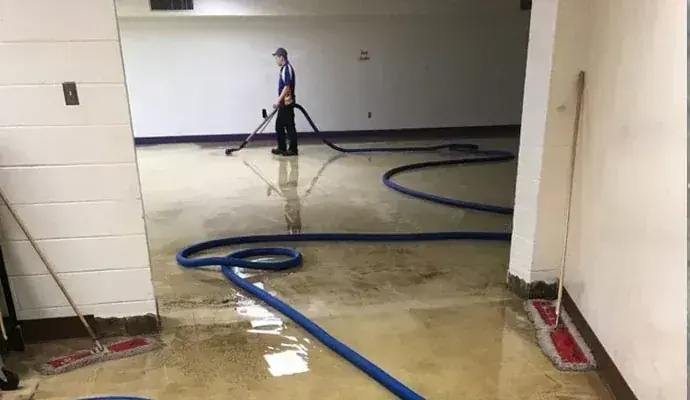
What to do the moment you find standing water
- Stop the source
Close the fixture valve or the main shutoff, often at the front hose bib or in the garage on Escondido slab homes.
- Kill power to wet circuits
Only if the breaker panel is dry and you can reach it without standing in water.
- Photograph before moving
Wide shots and close-ups of every wet room, before anything is lifted or thrown out.
- Lift and move
Get rugs, cords, boxes and wood furniture legs off the wet floor so they stop wicking water.
Water extraction is the first job on almost every Escondido water loss. A burst supply line, an overflowing tub or a garage water heater can put an inch of water across a slab in minutes, and every minute it sits it wicks further into carpet pad, baseboards and the bottom of the drywall. The extraction crew's job is to get the bulk water out of the building before the drying phase starts.
The standard behind every water extraction and removal job in Escondido
Rapid local response
The response team answers day or night and sends a crew with pumps, air movers and meters toward Escondido and the nearby North County cities.
IICRC S500 drying standard
IICRC S500 is the industry drying standard. The drying team maps moisture first and pulls equipment only when the readings say dry.
Claim-ready documentation
Most crews log daily moisture readings and take timestamped photos before any demolition, which is what an adjuster reads.
North County water experts
Slab leaks, hard-water pinholes, attic condensate and winter storm runoff are the losses Escondido homes actually have.
What does water extraction and removal cost in Escondido, CA?
In Escondido, CA, water extraction typically runs $300 to $1,500 for a single room and $1,500 to $4,500 when water reaches several rooms, with drying equipment billed on top.
- Truck-mounted pump-out
- Carpet and pad check
- Air movers staged
- Pad removal where needed
- Baseboard and wall checks
- Dehumidifiers added
- Porous materials removed
- Antimicrobial applied
- Containment set up
What moves the number: the water category, square footage that got wet, the flooring type, and how many hours passed before extraction started.
For a closer planning range, try the water damage cost calculator. Every range here is typical, not a quote.
Water Extraction and Removal in Escondido, step by step
- 1
Walkthrough and moisture map
The tech who does the walkthrough finds the source and maps how far the water traveled, using thermal imaging and pinless meters.
- 2
Extraction
The extraction crew pulls standing water with truck-mounted extraction so it leaves the building instead of moving to the next room.
- 3
Drying set to the room
The drying team sets air movers to each room's evaporation load and runs LGR dehumidifiers, with desiccants for Class 4 materials.
- 4
Daily readings to dry
Most crews record readings daily and pull equipment once wet materials sit within 2 to 4 points of a dry reference.
Why extraction decides the length of the dry-out
The drying team can only evaporate so much water a day, so every gallon the extraction crew leaves behind adds time. Truck-mounted units pull water from the carpet and the pad beneath it, not just the surface. Weighted extraction tools push down on the carpet so the pad gives up water it would otherwise hold for days.
- Carpet and pad: extracted, then the pad is usually replaced
- Tile and slab: squeegeed and extracted, then the wall base is metered
- Hardwood: surface water pulled, then drying mats go down (see hardwood floor water damage)
Moisture mapping before any equipment goes down
Before any fan or dehumidifier goes into the room plan, the tech who does the walkthrough maps where the water actually went. Pinless meters and thermal imaging show wet drywall and damp slab that look dry to the eye. That map becomes the drying plan and the first page of the claim file.
The EPA notes that wet building materials should be dried within 24 to 48 hours to limit mold, which is why the mapping and extraction happen together. See the EPA's mold and moisture overview.
When the water is not clean
Water that came from a washing machine, a dishwasher or a toilet tank is Category 2. Water from a sewer line or from outside flooding is Category 3. The extraction crew handles those with protective gear, and porous materials the water touched are removed instead of dried. Storm water that came in from a yard or street is treated the same way; Ready.gov's flood safety page explains why floodwater is handled as contaminated. For backups, see sewage backup cleanup.
Once the standing water is gone, the job moves to structural drying, and the cost calculator gives a planning range for both phases.
Water Extraction and Removal coverage across Escondido
The restoration team handles standing water in every Escondido ZIP and the neighboring North County cities.
The restoration team handles standing water across Old Escondido, downtown, Kit Carson, Bear Valley, Rancho San Pasqual, Hidden Meadows and Harmony Grove, plus San Marcos, Valley Center and Rancho Bernardo.
ZIP codes 92025, 92026, 92027, 92029 are all covered, along with the Escondido PO box ZIPs 92030, 92033, 92046.
See every neighborhood and ZIP coveredRelated water damage services in Escondido
Water Extraction and Removal: common Escondido questions
Can a wet-dry vac replace professional extraction?
A shop vac pulls a few gallons at a time and leaves most of the water in the carpet pad and the slab surface. Truck-mounted extraction pulls far more per minute and pulls from the pad, which is why the extraction crew uses it on anything bigger than a small spill.
Can wet carpet in an Escondido home be saved?
Often it can when the water was clean and extraction starts quickly. The drying team usually replaces the pad, floats or dries the carpet in place, and checks the tack strip. Carpet soaked by gray or black water is removed.
Why does extraction come before fans?
Air movers evaporate water from surfaces; they are not built to remove standing water. Pulling the bulk water first shortens drying by days and keeps moisture from moving into drywall.
How long can water sit before mold becomes a concern?
Mold can begin growing on wet materials within 24 to 48 hours, which is why extraction and drying are treated as urgent rather than scheduled for later in the week.
Does water on a concrete slab need extraction too?
Yes. Slab homes are common in Escondido, and water on a slab migrates under baseboards and into bottom plates. The extraction crew removes the surface water and the drying team checks the wall base with meters.
What happens to furniture and belongings?
The restoration team moves contents out of the wet area or blocks them up on pads, photographs them and sets aside anything that needs cleaning or a decision from you.
Water Extraction and Removal in Escondido? Call before it spreads.
The longer water sits, the further it wicks into slab, drywall, framing and flooring. The Escondido restoration team answers day or night.