Slab Leak Water Damage in Escondido, CA
A copper line leaking under the slab soaks flooring and wall bases from below. The restoration team finds the wet area, coordinates the plumbing repair and dries what the water reached.
(888) 450-9281Get help with a slab leak in Escondido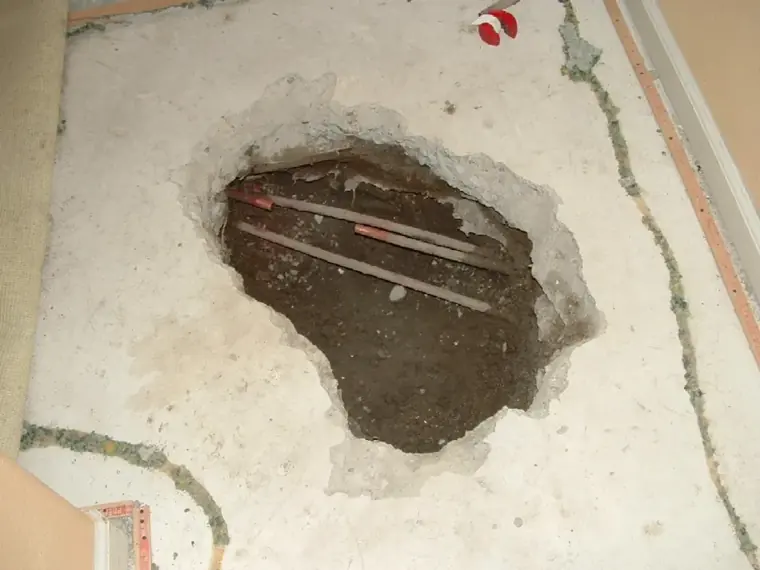
What to do the moment you find a slab leak
- Watch the water meter
Turn off every fixture; if the meter's leak indicator still spins, water is escaping somewhere.
- Shut the main
Closing the main stops the flow under the slab until the plumber isolates the line.
- Note the warm spots
A warm tile, a damp carpet edge or a hissing sound near a wall points to the leak area.
- Photograph the flooring
Take pictures of any lifting laminate, stained carpet or damp baseboard before it is removed.
Large parts of Escondido were built between the 1960s and the 1980s on concrete slabs with copper supply lines run underneath. Decades of very hard water and small ground movement wear those lines until one starts to leak, and the water spreads under flooring and up into wall bases long before anyone sees it.
The standard behind every slab leak water damage job in Escondido
Rapid local response
The response team answers day or night and sends a crew with pumps, air movers and meters toward Escondido and the nearby North County cities.
IICRC S500 drying standard
IICRC S500 is the industry drying standard. The drying team maps moisture first and pulls equipment only when the readings say dry.
Claim-ready documentation
Most crews log daily moisture readings and take timestamped photos before any demolition, which is what an adjuster reads.
North County water experts
Slab leaks, hard-water pinholes, attic condensate and winter storm runoff are the losses Escondido homes actually have.
What does slab leak water damage cost in Escondido, CA?
In Escondido, CA, drying and repairs after a slab leak typically run $1,500 to $6,000 for the water damage side, separate from the plumbing repair or reroute itself.
- Localized flooring lifted
- Slab and wall base drying
- Daily readings
- Laminate or carpet removed
- Wall bases opened
- Dehumidifiers and air movers
- Wide flooring removal
- Cabinet toe-kicks opened
- Extended slab drying
What moves the number: how long the leak ran unnoticed, the flooring over the slab, whether the leaking line was supply or drain, and how many rooms the water reached.
For a closer planning range, try the water damage cost calculator. Every range here is typical, not a quote.
Slab Leak Water Damage in Escondido, step by step
- 1
Walkthrough and moisture map
The tech who does the walkthrough finds the source and maps how far the water traveled, using thermal imaging and pinless meters.
- 2
Extraction
The extraction crew pulls standing water with truck-mounted extraction so it leaves the building instead of moving to the next room.
- 3
Drying set to the room
The drying team sets air movers to each room's evaporation load and runs LGR dehumidifiers, with desiccants for Class 4 materials.
- 4
Daily readings to dry
Most crews record readings daily and pull equipment once wet materials sit within 2 to 4 points of a dry reference.
How the water damage from a slab leak is found
The tech who does the walkthrough starts with the rooms around the suspected leak and works outward. Thermal imaging shows the cooler or warmer band where water is moving, and pinless meters confirm wet flooring and damp drywall at the wall base. The moisture map marks every wet area before any flooring comes up.
- Warm tile or carpet over a hot-water line leak
- Swollen laminate seams and cupped wood
- Damp baseboards and bottom plates along interior walls
Opening only what has to come out
Laminate, carpet pad and engineered flooring over a wet slab trap moisture, so the drying team removes the wet sections and leaves the dry ones. Baseboards are pulled and small holes are drilled at the wall base so air can reach the bottom plate. The plumber's access hole is left open until the slab around it reads dry.
The EPA's Fix a Leak Week page explains how to use the water meter to confirm a hidden leak, which is often the first clue in a slab home.
Drying the slab and the walls
Concrete gives up water slowly. The drying team runs LGR dehumidifiers with air movers aimed at the slab surface and records readings daily. Equipment stays until the slab and wall bases reach the drying goal, not until the floor looks dry. Hard water is part of why these lines fail, and the USGS explanation of water hardness covers why imported Southern California water scores so high.
If a slab home has repeat leaks, the plumbing age risk check gives a quick read on the rest of the system, and the cost calculator estimates the drying side.
Slab Leak Water Damage coverage across Escondido
The restoration team handles a slab leak in every Escondido ZIP and the neighboring North County cities.
The restoration team handles a slab leak across Old Escondido, downtown, Kit Carson, Bear Valley, Rancho San Pasqual, Hidden Meadows and Harmony Grove, plus San Marcos, Valley Center and Rancho Bernardo.
ZIP codes 92025, 92026, 92027, 92029 are all covered, along with the Escondido PO box ZIPs 92030, 92033, 92046.
See every neighborhood and ZIP coveredRelated water damage services in Escondido
Slab Leak Water Damage: common Escondido questions
How common are slab leaks in Escondido?
They are one of the more common hidden losses in the 1960s to 1980s ranch neighborhoods, where copper supply lines run under the slab and very hard water wears on the pipe for decades.
What are the signs of a slab leak?
A water meter that moves with every fixture off, a warm spot in the floor, damp carpet near a wall, cracked tile or lifting laminate, and a higher water bill are the usual signs.
Does the whole floor have to come up?
Not usually. The drying team maps moisture first and removes only the flooring that is wet or blocks drying. Tile over a dry area often stays in place.
Who fixes the pipe itself?
A plumber locates and repairs or reroutes the line. The restoration team handles the water damage: extraction, removal of wet materials and drying, and the documentation that goes with it.
How long does a slab take to dry?
A slab under a contained area often dries in three to five days with dehumidifiers and air movers. Thick slabs, long-running leaks and cooler weather push that longer.
Is slab leak water damage covered by insurance?
Many policies treat the resulting water damage differently from the pipe repair and from access costs. Coverage depends on your policy, so it is worth checking with your own insurer.
Slab Leak Water Damage in Escondido? Call before it spreads.
The longer water sits, the further it wicks into slab, drywall, framing and flooring. The Escondido restoration team answers day or night.