Structural Drying & Dehumidification in Escondido, CA
Surface-dry is not dry. The drying team sets air movers and LGR dehumidifiers to the load of each room and keeps them running until the framing, subfloor and drywall read dry.
(888) 450-9281Get help with wet framing and drywall in Escondido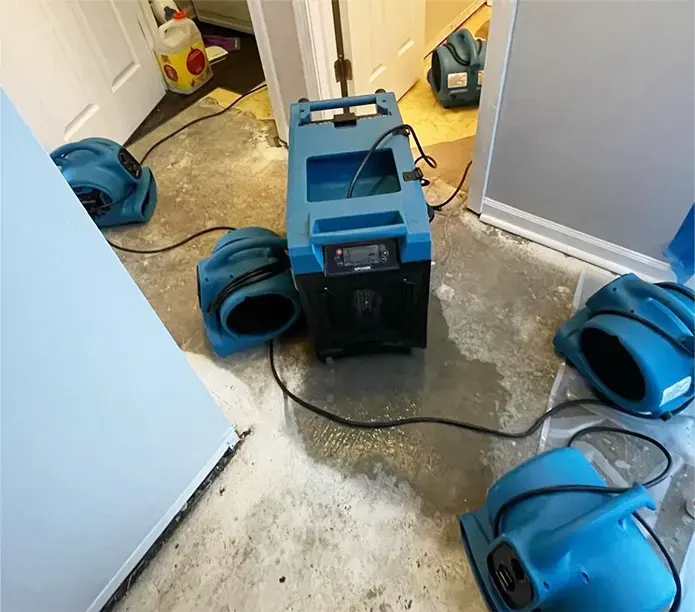
What to do the moment you find wet framing and drywall
- Keep the house closed
Open windows can bring in humid air and slow the dehumidifiers down.
- Leave equipment running
Turning off air movers or dehumidifiers at night resets the drying curve.
- Keep the thermostat steady
A comfortable, steady temperature helps; do not crank the heat or the AC.
- Keep doors as set
The drying team sets doors and containment for a reason; leave them as placed.
Structural drying is the part of a water loss that decides whether the problem comes back. Drywall can feel dry on the surface while the bottom plate behind it is still soaked. Escondido's dry inland air helps, but it does not dry a wall cavity or a subfloor by itself, especially in winter when the storms come.
The standard behind every structural drying and dehumidification job in Escondido
Rapid local response
The response team answers day or night and sends a crew with pumps, air movers and meters toward Escondido and the nearby North County cities.
IICRC S500 drying standard
IICRC S500 is the industry drying standard. The drying team maps moisture first and pulls equipment only when the readings say dry.
Claim-ready documentation
Most crews log daily moisture readings and take timestamped photos before any demolition, which is what an adjuster reads.
North County water experts
Slab leaks, hard-water pinholes, attic condensate and winter storm runoff are the losses Escondido homes actually have.
What does structural drying and dehumidification cost in Escondido, CA?
In Escondido, CA, structural drying typically runs $1,000 to $5,000 for a contained loss, based on the number of air movers and dehumidifiers and the days they run.
- Air movers
- One LGR dehumidifier
- Daily readings
- More air movers
- Multiple dehumidifiers
- Cavity drying
- Desiccant units
- Floor mats
- Extended monitoring
What moves the number: the class of the loss, the number of rooms, the materials involved, and how many days equipment runs before the readings say dry.
For a closer planning range, try the water damage cost calculator. Every range here is typical, not a quote.
Structural Drying and Dehumidification in Escondido, step by step
- 1
Walkthrough and moisture map
The tech who does the walkthrough finds the source and maps how far the water traveled, using thermal imaging and pinless meters.
- 2
Extraction
The extraction crew pulls standing water with truck-mounted extraction so it leaves the building instead of moving to the next room.
- 3
Drying set to the room
The drying team sets air movers to each room's evaporation load and runs LGR dehumidifiers, with desiccants for Class 4 materials.
- 4
Daily readings to dry
Most crews record readings daily and pull equipment once wet materials sit within 2 to 4 points of a dry reference.
How the drying plan is built
The tech who does the walkthrough maps moisture in every affected room, records a dry reference reading from an unaffected area and sets the class of the loss. The class decides how many air movers and dehumidifiers each room needs. Air movers are set to each room's evaporation load, not spread evenly.
- Class 1: small area, low-porosity materials
- Class 2: a whole room, carpet and lower walls
- Class 3: ceilings, walls, insulation and subfloor
- Class 4: hardwood, plaster, concrete and other dense materials
The equipment and the numbers
LGR dehumidifiers pull water from the air; desiccant units handle Class 4 materials and cooler rooms. The drying team records temperature, relative humidity and grains per pound each day, along with the moisture readings on the wet materials. Those psychrometric logs show the drying is working and go straight into the claim file. The EPA's indoor air quality page explains why damp materials matter for the air inside the house.
When equipment comes out
Equipment leaves when the readings say dry: the wet materials land within 2 to 4 points of the dry reference. Pulling it early because the walls look dry is how hidden moisture turns into odor and growth later; the EPA's mold guidance covers the risk. The drying-time estimator gives a rough planning range, and water extraction covers the step that comes first.
Structural Drying and Dehumidification coverage across Escondido
The restoration team handles wet framing and drywall in every Escondido ZIP and the neighboring North County cities.
The restoration team handles wet framing and drywall across Old Escondido, downtown, Kit Carson, Bear Valley, Rancho San Pasqual, Hidden Meadows and Harmony Grove, plus San Marcos, Valley Center and Rancho Bernardo.
ZIP codes 92025, 92026, 92027, 92029 are all covered, along with the Escondido PO box ZIPs 92030, 92033, 92046.
See every neighborhood and ZIP coveredRelated water damage services in Escondido
Structural Drying and Dehumidification: common Escondido questions
What is structural drying?
It is drying the building itself, not just the surfaces: framing, subfloor, wall cavities and flooring. It follows the IICRC S500 standard and ends when readings, not appearances, say the materials are dry.
What are Class 1 to 4?
The class describes how much water there is to evaporate. Class 1 is a small area with low-porosity materials; Class 3 is a wet ceiling, walls and floor; Class 4 is dense materials like hardwood, plaster and concrete that hold water tightly.
What is an LGR dehumidifier?
A low grain refrigerant dehumidifier pulls more water out of the air than a standard unit, especially as the air gets drier near the end of a job.
Why is equipment so loud and why must it stay on?
Air movers push air across wet surfaces to speed evaporation, and dehumidifiers remove that moisture from the room. Turning them off lets the air saturate again and slows the job.
How is dry verified?
The drying team compares readings in the wet area to a dry reference material in an unaffected part of the same building. Equipment comes out when the wet material is within 2 to 4 points of the reference.
How long does structural drying take?
A contained Class 1 or 2 loss usually dries in three to five days. Class 4 materials and cooler, humid weather can take longer.
Structural Drying and Dehumidification in Escondido? Call before it spreads.
The longer water sits, the further it wicks into slab, drywall, framing and flooring. The Escondido restoration team answers day or night.